Reconstructing Truth, Deconstructing ADHD Badiou, onto-epistemological violence and the diagnosis of ~ADHD~
Key/ Abstract:
Focal point is on children and education - but the core principles approach neurodevelopmental diagnoses as such and as a reason to revisit pedagogy around "power imbalances" rather than medicalised/ "chemical imbalances" or a single view of "being".
Used #Badiou's ontology maths (simplifying) which argues against totalizing (reducing to a single unified thing) Being qua (being) Being
Dialogical Self in a Complex World: The Need for Bridging Theories
Introduction
"This Article argues that the diagnosis of ADHD is violent"
Argues that diagnosis (of ADHD but I can see how applicable elsewhere) is a form of #ontoepistemological violence
#epistemologicalviolence "rendering a fragmentary and reductionist knowledge production" - reducing what counts as knowledge to, for example, what is "objectively" and neutrally measured by people wearing safety goggles. (Shiva 1988) MINDFULNESS BOOK
#ontoepistemology is from Karen Barad - [[Barad, K. (2011) - Nature's Queer Performativity.pdf]] Barad, K. (1996) - Meeting The Universe Halfway.pdf
What Physicists Don't Want You to Know About Quantum Mechanics
- "epistemological mattering" - knowledge counting as knowledge
- "ontological articulation" - the human idea of it (here, the world)
#ontoepistemologicalviolence is Sjobergs intervention, from reading Badiou, who argues that "mathematical set theory" is the only onto-epistemologically non violent language available to speak about being
- because why? its refraction rather than reduction? Notes on Things/Film and TV/Annihilation
quote from Dahlbeck (2018) i like
argues that educational researchers should not stop asking metaphysical - eternal - questions "because our different ways of answering them will continue to shape how we live" (244)
Argument:
**"In This article, I argue that thinking about being in new ways is crucial, as is the need to seek out a less violent educational model other than the one facing an (ever-increasing) group of diagnosed individuals" (244)
How successfully is this argued?
- thinking again about all the various ways of being that have been #criminalised and #medicalised - homosexuality for instance. "ADHD" and neurodevelopmental diagnoses as another - individualising a non-problem that only becomes a problem under the strictures of the world we have made.
- and the restrictions of being individuals with these characteristics, which are subject to discrimination under those strictures needing to seek out diagnosis to survive them - and, to an extent, medication. Or engaging in criminalized behaviours such as "recreational" drug use.
The one, the other and the truth
"those members of society who challenged and reluctantly conformed to the (desireable) order of the state have caused educational concerns and effort... technological rationality has come to play a crucial role in rendering production in society more efficient, thereby leading to an enormous apparatus of classification and and increased belief in the instrumentalization of educational processes" (244)
"apparatus of classification" - diagnostic process, school systems approaching #adhd as a deficit to be managed in educational setting and also as something that can only be excused once it has been properly recorded - thinking about that study about neurotypical responses to autistic people First impressions towards autistic people a systematic review and meta‐analysis
- that once the reason "i am autistic" is given the judgement softens, and this is presented as a neutral adjustment to new information rather than as evidence of discrimination - the kids who bullied me didn't do so because I fit the category "autistic" that existed in their minds but rather because the behaviours and characteristics and mannerisms were inexcusably odd and oddness is socially punished - Sedgwick Epistemology of the Closet (I want to get to typing up my notes on that soon) but thinking about the way that the binaries - autistic and allistic etc. are created as fear of power being upended, out of fear for what it means. "Symptom" is an interesting word.
"Inseparable from this is the "eternal" philosophical and educational questions of how to live and work toward a true and good life" 244
Badiou's answer - "we have to take responsibility for the actual which is constantly generated by (four) various truth procedures - science, politics, art, love - making up the world we live in"
truth as "always particular and comes into existence depending on the local structures within a situation" - reality as discursively co-constituted (who?)
- against sophistry - sophistry the approach that treats Truth as whatever can be most effectively argued for, and not something that can be discovered or known
- Truth as local - applies to the particular situation and circumstances.
(struggling to understand how local, generic and particular function here )
universal value vs. universal morality? "directed at the general and not the particular" - this is the totalizing approach of Humanism, "human rights" discourses - that there is a universal set of expectations on the human, and anything beyond or outside of that is not subject to morality and where "certain interests take it upon themselves to pity and intervene against what, from the perspective of a dominant "One", is presented as an a priori existing "Other"" 245
Biopolitical control: "an intervention in minority bodies/ brains to re/produce a social order in accordance with the privileged position of a dominant "One" - reinforces hierarchy, focused around "efficiency" as an absolute value, reproducing inequality - ADHD medication and educational approaches as forming these interventions.
it is in the impossibility to totalize being that the possibility of change is to be found. This is why we should never cease questioning those who try to totalize being from the perspective of "One" and, at the same time, never give up on the idea of change
what is being changed?
The "critical case" of ADHD
- ADHD as "genetic or neurochemical dysfunction manifested as a mental/cognitive disorder" - dysfunction in what context (what is functional), disorder against what order?
- non-neutrality of psychiatric diagnosis - what is being diagnosed is contextual, the requirement for diagnosis as a process is to identify and control difference - divergence from a norm or set of expectations of how humans should be
- focus in diagnostic process on deficit figured as deviation from expected human behaviours
- ADHD medication as making conforming to expectation easier - expectation of control over focus and attention, giving the medicated individual the ability to produce work as efficiently as required
- Addiction and ADHD - self-medication or reaction - a de-instrumentalization of the individual
Various researchers have raised concerns that a psychiatric (or so-called neurodevelopmental) diagnosis serves a number of different interests at the same time as the diagnosed individual is transformed into a technological object, which in turn enables social control over, and instrumental modification of, behaviours not following a conformist order (245)
Baker (2002) - diagnostic process as nothing but "repressive eugenics"
Children (students) only become dysfunctional when they are not sufficiently productive (at school), after which they are to be seen and treated as a risk and a burden to society
dominance of biomedical model - downplays uniqueness of diagnosed subjects
"In Other words, due to a lack of empirical evidence, the diagnosis is based instead on ideology... legitimized on the basis of a utility-based humanitarian principle" 246
The quasi-humanitarian and utility-based diagnosis of ADHD
- critique of Gillberg's arguments for ADHD as "an innate neurological dysfunction manifesting itself in a mental and behavioural disorder"
- diagnosis of ESSENCE - the essential characteristics of the child which create "risk" of developing future social problems - a disordered or dysfunctional relationship to the dominant social order.
Diagnostic process - especially with children but also in adults - includes the perspectives and outside observances of teachers, parents etc. rather than the child's account of their own needs and struggles to meet the arbitrary and restrictive expectations of the educational and broader social structures with which their behaviours and characteristics conflict. Diagnosis as a gatekeeping of accommodations ==designed not to support the child to do what the child finds important and interesting but to force the child (and all children to an extent) to find important and interesting the same things the educational system deems important and interesting.
Gillberg (2014) states that people with 'ADHD' must be approached on the basis of systematic psycho-medical knowledge providing an adequate understanding of 'ADHD' as a neurological dysfunction. However, there is no consensus on the causes behind the diagnosis (aetiology), which may explain why 'ADHD' manifests itself heterogeneously. While pointing out that everyone with 'ADHD' frequently see themselves as normal, while the so-called disorder is to be found in the opinions of others.
'ADHD' diagnosis as having utility as a prophylactic measure against stigmatization and source of "belonging"
- reminds me again of that study about autism - non-autistics evaluate autistic modes of communication negatively until autism is given as a reason for the socially deviating behaviour or affect.
Clippings/First impressions towards autistic people a systematic review and meta‐analysis
Morrison et al. (2019) - Variability in First Impressions of Autistic Adults.pdf
Diagnosis as a form of treatment in itself - legitimization of the differences contained within what is diagnosed, as an explanation for the unfitting, and the personal inability to conform.
- Byung-Chul Han - diagnoses such as depression, ADHD, BPD as characteristic of the current age - "signature afflictions"
diagnosis from a reverse-logic:
the diagnosis as a theoretical construct seeks medical-psychiatric and techno-scientific validation at the same time as the diagnosis serves certain functions in relation to individual and society as formulated by dominant interests. The diagnosis is pure ideology, and as such it supports an educational model emphasizing identity over diversity... Utility outweighs risk, according to the prognosis determined via the diagnosis. (248)
Gillberg's argument as representative of wider discourses and truth-claims around 'ADHD' as a form of onto-epistemological violence. "pure ideology" do I have to read Zizek?
Treated as a rat: onto-epistemological violence and the fragmentary 'ADHD'-subject
"an ontological examination of Being qua being entails searching for what is universal for everything that exists" (249) Does it?
"Badiou highlights an increasing contemporary belief in an ideologically driven techno-scientific positivism seeking to make us uncritically seduced in its attempt to totalize being" (249)
- techno-scientific positivism - the belief that it is possible to positively and definitely discover "the real" as a static and total thing through technology and empirical scientific observation. "If it is true here on Earth, it is true on XYZ" BBC Open University Docs it is a mantra. And how these attempts fall apart at different, non-human scales - the cosmic scale of Black Holes and the quantum scale of Strings. gravity is a social construct New Scientist black holes stuff. [[Haraway, D. J. (2016) - Staying with the Trouble.pdf]]
not anti-scientific or anti-technological - Badiou's ontology is based in maths (SET THEORY) after all. rather ==against totalizing ontologies. ==
Set Theory
Clippings/Set theory (Math.net)
"At its most basic level, set theory describes the relationship between objects and whether they are elements (or members) of a given set. Sets are also objects, and thus can also be related to each other typically through use of various symbols and notations."
(emphasis mine)
Mathematical set theory as a foundational building block - making it possible to precisely define mathematical concepts.
| Symbol | Definition/meaning | Example |
|---|---|---|
| Indicates a collection of elements | ||
| ∅ | Empty set - set contains no elements | {} |
| ... | Indicates that the set continues the pattern in the corresponding direction towards negative (left) or positive (right) infinity | |
| | | "Such that" | a∈ℤ | a > 3 - "a is an integer such that a is greater than 3" |
| ∩ | "and" or "intersection" | A = {1, 2, 3, 4} B = {4, 5, 6} A ∩ B = |
| ∪ | "or" or "union" | A = {1, 2, 3, 4} B = {4, 5, 6} A ∪ B = |
| ⊆ | Subset - A is a subset of B if all its elements are included in B | {1, 2} ⊆ {1, 2, 3, 4, 5} {1, 2, 3, 4, 5} ⊆ |
| ⊂ | Proper/strict subset - A is a proper subset of B if A is a subset of B, but not equal to B | {1} ⊂ {1, 2, 3, 4, 5} {1, 2} ⊂ {1, 2, 3, 4, 5} {1, 2, 3} ⊂ {1, 2, 3, 4, 5} {1, 2, 3, 4} ⊂ |
| ∈ | Element of - indicates that the object on the left of the symbol is an element of the object on the right | x∈ℚ - "x is an element of the rational numbers" |
| 𝕌 | Universal set - the set of all possible values | A = {1, 2} B = {3, 4, 5} 𝕌 = |
| Ac or A' | Complement - all the elements not in set A | 𝕌 = {1, 2, 3, 4, 5} A = {1, 2, 3} Ac = |
| [a, b] | Closed interval - values between a and b including a and b | [1,4] = {1, 2, 3, 4} if only including integers |
| (a, b) | Open interval - values between a and b not including a and b | (1,4) = {2, 3} if only including integers |
| |A| | Order/cardinality - number of elements in the set | A = {3, 6, 7, 9} |A| = 4 |
| ℕ | Natural numbers - only positive numbers with no decimals or fractions | |
| ℤ | Integers - all positive and negative numbers with no decimals or fractions, including 0 | |
| ℚ | Rational numbers - a number that can be represented as a fraction comprised of integers | ⅔ |
| ℝ | Real numbers - rational numbers and irrational numbers | π, e, 3, ½, 0.25 |
| ℂ | Complex numbers - numbers made up of a real and imaginary component | 4 + 2ⅈ |
Order of sets = the size of the set
Finite order = "the order of the set is determined by the number of elements in the set"
- if it has 5 elements, the order of the set is 5 - maps 1:1, but this applies only to sets where the number of elements is knowable and definable
So, sets with a finite order can be sorted according to the number of elements - see link for examples.
Subset - a set whose elements are also contained in another set, but it has fewer elements
(thinking about taxonomy might help here?)
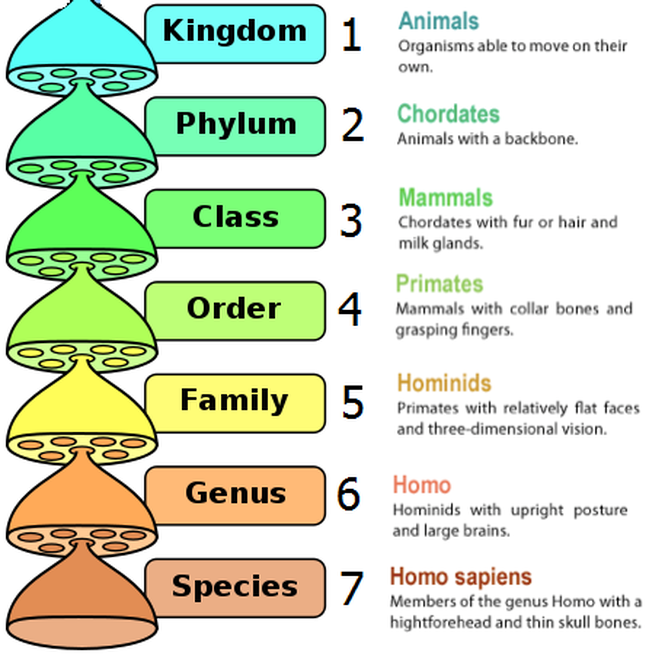
(so a species is a subset of a genus, which is a subset of a family etc. etc.) (I think?)
Empty set - where two sets with no elements in common intersect (like a venn diagram with two separate circles)
Mutually Exclusive sets - two sets of which one is the subset of the other, so there's no need to include both in the order
_(it's not that I think autism exists as a "real" thing that exists in the world but rather that I feel I have the characteristics defined and interacted with as autism, or rather that autism is the word we have access to which defines these experiences and how the world interacts with us around it. #Autism is what we call this set of behaviours and characteristics) Burnout; An epistemology of the exhausted
Union - the set that results from combining two intersecting sets.
Infinite sets - the ==order is determined by something other than the number of elements in the set
Countably Infinite Sets - "Any infinite set that can be paired with the natural numbers in a one-to-one correspondence such that each of the elements in the set can be identified one at a time is a countably infinite set." - overcomplicating the concept of counting - if you can look at the number of elements in a set and start going 1, 2, 3, 4, 5, even if you do not know without counting them 1 by 1 how many elements there are. So I suppose a species is a countably infinite subset of a genus? We might not know without counting every single different kind of beetle how many creatures (elements) belong to the Beetle set, but we can go one by one counting all the different ones we come across?
Uncountably Infinite sets - ???????????????????????????????????????? - something about real numbers in between the numbers?
Wikipedia defines a real number as "a number that can be used to measure a continuous one-dimensional quality such as distance, duration or temperature. Here continuous means that pairs of values can have arbitrarily small values" https://en.wikipedia.org/wiki/Real_number (bold mine)
from the table above:
| ℕ | Natural numbers - only positive numbers with no decimals or fractions | |
|---|---|---|
| ℝ | Real numbers - rational numbers and irrational numbers | π, e, 3, ½, 0.25 |
using the example of the real numbers (decimals, to any number of places after the '.' ) in between 0 and 1 (e.g. 0.2, 0.54, 2/3) - these cannot be counted using "natural numbers" because there are uncountably infinite "Real numbers" in between 0 and 1.
"because there are real numbers between any two distinct real numbers, there are no natural numbers to map to the real numbers between 0 and x1, x1 and x2, and so on. Thus, the set is uncountably infinite."
Back to the text
"Badiou argues that being is an infinite multiple" - uncountably infinite set - not possible to count.
In other words, the substance of being is void: void is an indiscernable no-thing, an unnameable that is completely neutral beyond technological and literary definitions, but which through various forms of situational operations - generic truth procedures - are forced into the world as hierarchical differences.
... Infinite multiplicity as pure alterity is not difference; it is nothingness, the unnameable, and this is what I relate to the uniqueness (the 'Real Being') of each and every one. Thus, being is neither one nor multiple. It is a multiple of multiplicities and as such, in the end, it is nothing. What Badiou argues is that each attempt to capture and elusive being generates new truths. (248)
comparison to Plato's cave - the distortion of the real occurs when it is "forced into the world by certain dominant interests, where these dominant interests also do what it takes to re/produce a specific (capitalist) state of order presented as the best of all possible alternatives" (paraphrasing Badiou) (248-249)
ADHD diagnosis as performing this kind of distortion - reducing the experience or being of the diagnosed subject to chemical imbalance, symptomology, the set of problematized behaviours
the "truth" invoked with diagnosis "it sets being in motion and thus makes the one labelled as 'ADHD' and the world appear in a certain way". (249)